Tampilkan postingan dengan label Hiking. Tampilkan semua postingan

Kamis, 06 Oktober 2016

Reminder: October 14th is a National Day of Adventure

As I get ready to head out of the country once again tomorrow, I wanted to take this opportunity to remind everyone that next Friday – October 14, 2016 – had been declared a National Day of Adventure by Men's Journal and Victorinox, the company behind the iconic Swiss Army Knife.

While not an official holiday of course, the entire point of the NDOA is to encourage people to get outside, engage in their favorite outdoor activities, or perhaps even try something new. To that end, the two sponsors of the Day of Adventure have helped organize more than 30 events across the U.S. to give us all a starting point for getting our adventures off to a good start.

While I'll actually be in Spain on that day, I'll certainly take some time to hit a trail and do some hiking, or possibly even some snorkeling in the Mediterranean Sea. And since it is a Friday, hopefully some of you will take part in the celebration by heading out to enjoy your own adventures too. Why not skip out of work early, grab your mountain bike and take a ride on your favorite trail? Or, gather up some friends and take a scenic hike somewhere before grabbing some dinner and drinks afterwards. The whole point is to add a little excitement and adventure back into your life, something that hopefully we do on a more regular basis than one day a year, but it is a good place to get started never the less.

So, whether your like to ride, hike, run, paddle, fly, climb, or some other crazy outdoor activity, don't forget to set a little time aside to pursue that passion next Friday. After all, you'll never regret the days that you do the things you love, and you might just discover other passions along the way.

Get out there and enjoy!

Kamis, 29 September 2016

Adventure Tech: goTenna Extends Backcountry Communication with New goTenna Mesh

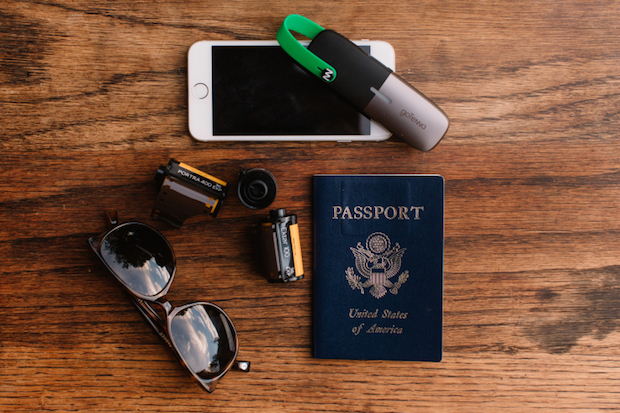
Earlier in the year I took a look at an innovative method for staying in communication while in the backcountry called goTenna. This simple, but effective device, connects to your smartphone via Bluetooth technology, and allows you to send text messages and share your GPS location with others who are equipped with a goTenna of their own. In a sense, the device creates its own data network for use in places where shell service is nonexistent, and while it doesn't facilitate voice comms, I found it very useful for staying in touch nonetheless. Now, the team at goTenna is back with a new product, and while it works in much the same way as its predecessor, it has the potential to extend the range of the device much, much further.

Dubbed the goTenna Mesh, this new unit launched on Kickstarter yesterday. A bit smaller than the original model, this new device brings some interesting new technologies to the table that should make it more useful to travelers, backpackers, climbers, and other outdoor enthusiasts. For instance, the Mesh now operates on UHF radio frequencies, which have brought it's out-of-the-box range down slightly, but make it more adaptable to a wider variety of environments, including both the outdoors and interior spaces. Switching to UHF has also allowed goTenna to bring their product abroad too, opening it up for sale in foreign countries where the previous generation's VHF radio waves were not allowed.

But more importantly, as it's name implies, the goTenna Mesh brings "meshing" technology to users as well. This allows the device to relay data that is sent to it on to other users, thereby extending the range almost indefinitely. Where as the original goTenna simply blasted out the messages that it broadcasted to all other goTenna users in range, the Mesh can analyze the data, and then rebroadcast it to others too. In this way a message that is sent can potentially reach a recipient, even if they weren't in range of the original sender.


The first generation goTenna has a range of about 1 mile in urban settings and 4 miles in rural areas, although greater ranges can be achieved depending on elevation and so on. The goTenna Mesh has a similar range when used for peer-to-peer communications, with 1 mile in cities and 3 miles in the backcountry. But, since it has the ability to relay data, a message can hop from one device to the next, provide there are several of them working within range of one another. So while two Mesh devices might have a range of roughly three miles, three or four units working together could stretch that range considerably further.

When goTenna launched the Kickstarter campaign for the new Mesh model it was with the hopes that it would generate $150,000 in crowdfunding to help get the device into production. Just 24 hours later, the campaign has generated $132,000 and climbing. That means that the new product should begin shipping in December as expected, with a price tag of $179 for two units. Of course, a third goTenna Mesh is really needed to see the true benefits of this second generation model, but this is certainly a good start. Early-bird contributors can reserve their goTenna Mesh units for as little as $129 by pledging to support the Kickstarter campaign now however.

In addition to revealing the Mesh, the company is also launching a new service called goTenna Plus. Users who sign up for this plan receive additional benefits from the goTenna app that is installed on their iPhone or Android device, including improved topographic maps for sharing your location, tracking of speed and distance while out hiking, and even sharing your current location with a designated individual on a set schedule, much like a SPOT Satellite Messenger. goTenna Plus users can also take advantage of network relaying which allows a device that is connected to a cell network to pass along goTenna messages to other users in that way too.

goTenna Plus is normally priced at $29 for a year, but is currently available at an introductory price of just $10. Seems like a pretty reasonable rate to me.

Find out more about goTenna and all of its gadgets at goTenna.com.


Selasa, 27 September 2016

Nat Geo Gives Us the Best Outdoor Towns in the World

Looking for a great town to serve as base camp for your next outdoor adventure? Thinking about relocating to a place that offers more opportunities to pursue the things you love? Why not let National Geographic help with their picks for the world's best towns for outdoor thrills.
Some of the places earning a nod include towns that you would expect. Places like Moab, Utah and El Chaltén, Argentina. Others are a bit more unexpected, such as Niseko, Japan or Ely, Minnesota. It isn't as if those places weren't known for being great outdoor destinations, but to see them ranked amongst the very best (Nat Geo names nine places in total), is refreshing to say the least.

Each place is also accompanied by a nice description of why it deserves a spot on this very distinguished list with details on what it has to offer for visitors. Nat Geo even provided information on when it is the best time of the year to visit to take advantage of the opportunities that each place has to offer. For instance, summer can be hot in Moab, so September is a good time to go, although the author says not to overlook winter as well. Meanwhile, if you're planning on going to Niseko it is probably for the skiing, which is best between December and February.

Of course, with such a short list some places had to be left off, but there were a few surprises for towns that do not appear here. For instance, Chamonix, France is considered one of the great outdoor meccas of the world and yet it doesn't appear on Nat Geo's radar. Similarly, you could just as easily have substituted places like Boulder, Colorado or Jackson Hole, Wyoming, amongst other great mountain towns in the U.S. Still, the places that were selected are very deserving, and bring a nice exotic flair to the list with places like Australia, South Africa, India, and Peru enticing travelers.

To find out which places made the cut, read the entire list here. Then come back and leave a comment with the places that you think should have made the cut. After all, some of your favorite places probably didn't make it.

Senin, 26 September 2016

Gear Closet: Merrell Capra Venture Hiking Boots

As many of you know, last week I traveled to Bryce Canyon in Utah to test out a bunch of new gear from my friends at REI. I knew that while I was out there we would be backpacking through remote sections of the national park and camping in the wild. I saw that as the perfect opportunity to try out some new hiking boots as well, thinking that a couple of days on the trail would make the perfect testing grounds. Turns out the weather we encountered in Bryce was wild too, ranging from light rain to heavy downpours, followed by hail, gale-force winds, flash floods, tornadoes, and the occasional bout of sunshine. In short, it was exactly the kind of weather you need to see just how good your gear truly is. Thankfully, I made a good decision when it came to footwear.

For this trip, my boot of choice was the new Capra Venture from Merrell. These lightweight and very comfortable boots are a new addition to the company's line-up this fall, and being a big fan of the footwear that Merrell produces, I was eager to see how well they performed on what was expected to be a challenging, but dry, hiking trail in Bryce. It was far from that however, and over the course of two days of backpacking, we encountered conditions that would test the resolve of any boot. Thankfully, the Capra Venture met that challenge nicely, and kept my feet well protected the entire time.

This boot features a couple of new components to the outdoor industry that I was looking forward to putting to the test. Those included the new Gore-Tex Surround materials and the Vibram Megagrip outsole. Gore-Tex Surrounded as been specifically designed to create a more breathable, yet still waterproof, boot that can be worn in warmer environments. That's exactly what I had in mind when I chose it to take with me to Bryce Canyon, but due to heavy rains and cooler temperatures, my Capra Ventures were forced to deal with far more water and moisture than anticipated.

So how did they hold up? Very well for the most part. The shoes kept my feet warm and dry for the bulk of the trip, which included crossing through swollen streams, walking in lots of mud, and hiking in incessant rainstorms. Late in the afternoon on our first day out in Bryce my feed did start to get a little damp, but considering the amount of moisture we were facing on the trail this was more of a case of the boots soaking out, and possibly getting some moisture in over the top from y saturated shell pants, more than anything else. Either way, it wasn't a great deal of water that made its way inside of the boots, but it was worth noting nonetheless.


In terms of traction, the Vibram Megagrip performed extremely well too. Walking on slick trails throughout both days in the park, I was able to keep my footing without too much trouble at all. That is to say, when the outsoles had a chance to actually grip the ground. There was so much mud collecting on the bottom of the boots that it was difficult to keep them clean. This happened to everyone on the trip, no matter what type of boots they were wearing at the time. But when the soles of the Capra Venture actually touched the surface of the ground, they held firm and reliably, instilling a great deal of confidence in the guy wearing them.

Aside from these two new innovations, Merrell has brought a great deal of other design elements that I appreciated greatly. For instance, the boot has a nice low profile that looks good and feels very comfortable on your feet. It also happens to be fairly lightweight when you consider the level of protection it brings to the table. While the ultralight backpacking crowd are sure to prefer something else, those of us who would rather hike in boots will certainly enjoy the lack of bulk and weight here. Best of all, Merrell has still built the shoe to provide plenty of protection and cushioning, as at the end of the day my feet and legs still felt strong and ready to go.

Built with a bellows tongue to help keep debris out of the interior of the boot, the Capra Venture also comes a nicely molded footbed to provide comfort and support. As a result, these boots were comfortable on my feet immediately and required a very minimal amount of break-in time before they were ready to go. I experienced no hotspots, blisters, or abrasions after two hard days on the trail, and thankfully I didn't end up getting any mud, dirt, rocks, or any other unwanted debris inside the shoe. At the end of the trek, my feet were in just as good of condition as they were went they set out, which is about all you can ask for out of a pair of boots.

In terms of durability, the Capra Venture once again impresses. I wouldn't expect a boot to show much wear and tear after just a couple of days on the trail, but my pair was put through the wringer and still managed to come out looking practically brand new. That is, after I hosed off all of the mud and dirt that had accumulated along just about every surface. Once cleaned and dry, I was hard pressed to be able to tell that they had not been just taken out of the box, despite miles of hiking in poor weather conditions.

If you're in the market for a new pair of backpacking or trekking boots, and you're looking for something that can provide plenty of protection without a lot of weight, the Merrell Capra Venture is a great choice. It not only comes packed with the latest fabrics from Gore and a new outsole from Vibram, it has decades of Merrell's heritage behind its design too. The result is a boot that is meant for those of us who hike longer distances while carrying a sizable load in in our backpacks. On the Bryce Canyon trip my pack was stuffed with all kinds of gear, including a new three-person tent that I was carrying by myself, but these boots still kept me fresh, moving fast, and feeling strong.

Priced at $230, the Capra Venture is about inline with what I would expect to pay for a very good backpacking boot. The fact that they are so lightweight and comfortable however puts them in a bit of a class all their own, and in my eyes makes them well worth the cost for someone who needs this level of performance. This isn't a boot designed for a short hike on a perfectly groomed trail on a Saturday morning – although it would do just fine in that environment. Instead, this is outdoor footwear built for adventures in rough and tumble places. It's meant for hiking longer distances and for trekking in remote places. If that's where you find yourself heading on a regular basis, the Capra Venture is definitely a boot for you.


Senin, 19 September 2016

Gear Closet: Osprey Manta AG 28 Daypack

If you're a regular reader of my "Gear Closet" stories here at The Adventure Blog, you probably already know the I have a habit of going on at great length about the product that I'm writing a review for. That is likely to be the case with the Manta AG 28 from Osprey as well, but for those of you who would rather get to the bottom line on this bag, I thought I would save you some time. So, for those folks wondering whether or not this pack will get a good review, let me just tell you now. It is amazing. Go buy one. Thank me later.

For those of you who are still around, we can now get into the details.

The Manta line of packs have been a part of the Osprey catalog for some time. But this pack, which was released this past spring, adds a nice new dimension that truly helps to separate it from the crowd. The "AG" in the bag's title stands for "Anti-Gravity" which is the name given to Osprey's innovative suspension that not only helps the pack to sit more comfortably and naturally on your body, but it can effectively carry more weight over a longer distance too.

The Anti-Gravity suspension was first introduced on Osprey's Atmos series, which is designed for backpacking and adventure travel. But now, it has trickled down to these daypacks as well. The suspension really does make a noticeable difference, and the integration of the mesh backpanel plays a big role in keeping you cooler and drier while hiking.

I have to say that I was a bit skeptical that the AG system would have as big of an impact on a daypack as it does on the larger backpacking models. But, after putting this bag to the test in the field, I can honestly say that my doubts were unfounded. The suspension is remarkable, and I think you'll find yourself coming off the trail at the end of the day feeling much better than you would with a traditional daypack without AG integration.


The Manta comes in three sizes – 20L, 28L, and 36L. (There is also a women's specific model called the Mira that comes in 18, 26, 34-liter models.) For me, the 28L version is the sweet spot for a daypack, offering plenty of room to carry everything you need, without getting so large that its starting to infringe on the small backpacking pack level. Of course, your particular needs may be a bit different than mine, but I found the 28L Manta to be just right.

As you would expect from a pack from Osprey, the Manta comes with a wide variety of pockets to store all of your gear. From its cavernous main chamber to the front pocket with mesh organizational sleeves – complete with key fob – this pack has plenty of ways to keep all of your important items organized and close at hand. There are also two surprisingly large pockets on the hipbelt as well, which I always appreciate for storage of small items such as snacks or my phone.

In terms of staying hydrated, the Manta comes with dual water bottle holders that can be found on each side of the bag, as well as a dedicated hydration sleeve. Osprey even throws in a high-quality 2.5 liter hydration bladder, which is a nice addition considering many companies require you to buy one separately. Considering the price of this pack, and all of the features it brings to the table, it was really nice to open the hydration sleeve and find the bladder tucked away inside.

That isn't the only nice little detail that Osprey has included on this pack. It also comes with its own integrated rainfly, which should be a common practice these days, but surprisingly isn't. There is also a helmet attachment loop for when you're cycling or climbing, and stretch mesh front pockets for quickly storing away extra gear, including a spare pare of shoes. Of course, Osprey has made always been good about paying attention to details, but it is nice to see that tradition continue here.

All of these features aside, the best thing about this pack is just how comfortable it feels when you're out on a hike. I can load it up with just a few small items, or stuff it to the brim with way more gear than I'll need, and it not only happily swallows up everything I throw at it, it feels good on your back too. The AG suspension is a true revelation, and a welcome addition to the daypack line. And of course, this being Osprey, the pack is very durable too, but still comes backed with the All Mighty Guarantee, which says the company will repair or replace the bag for its lifetime. You can't ask for better coverage than that.

As if all of that weren't enough, the Manta AG 28 costs just $165, which is a relative bargain when you consider everything this pack brings to the table. It is filled with excellent design decisions, includes the best suspension system on the market, offers lots of carrying capacity, and it is durable enough to survive just about anything you throw at it. It also comes with a built-in rain cover and has an excellent hydration sleeve that you'll want to use in all of your other packs as well. All of that adds up to an excellent daypack that you'll certainly want to have with you on your future hikes and adventure travel excursions.

This is the best daypack I've ever used, bar none. I think you're going to love it too. But it now at REI.com, CampSaver, or Backwoods.


Osprey Packs | Manta/Mira AG™ Product Tour from Osprey Packs on Vimeo.

Selasa, 13 September 2016

Backpacker Gives Us America's 10 Most Dangerous Hikes

When most of us decide to go for a hike we generally tend to hit local trails that are scenic, fun, and even relaxing. But not all trails fit that description, with many being down right difficult and demanding. Then of course, there are the ones that are actually quite dangerous.

That's the subject of a great article put together by Backpacker magazine, which takes a look at the 10 most dangerous hikes in the U.S. The list contains some iconic treks across the country, as well as some lesser known trails that have a reputation for being incredibly difficult. In fact, if you go unprepared on these hikes, you could get seriously hurt or even killed.

Some of the hikes that make the list include Bright Angle Trail in the Grand Canyon, which is known for being a challenging walk in hot conditions the often leaves those who aren't prepared dehydrated and exhausted. The Maze in Utah on the other hand will confound even the most navigationally savvy, while the infamous Mt. Washington in New Hampshire blasts hikers with its high winds, which tend to blow furiously all year round.

I won't give away the entire list, as the article is well worth a read by everyone. I will say however, that each of the entires definitely has an element of danger to it, which could cost the inexperienced and unwary their lives. Thankfully, Backpacker has some suggestions on how to avoid these challenges, and survive each of these beautiful but difficult hikes.

Check out the entire list here.

Senin, 12 September 2016

Gear Closet: Five Ten Access Mesh Approach Shoe

It is amazing how technical and specialized our outdoor footwear has become. In the past, we made due with a single shoe that could serve in a variety of outdoor uses. Today however, we've gotten to the point where having the right footwear is akin to having the right tool for a job. Good shoe manufacturers are constantly looking for ways to improve their products and make them better for use in demanding outdoor environments. As a result, the shoes we wear are now highly tuned to the activities we enjoy, and we're all better off for it.

One company that has continued to refine its product line in this way is Five Ten. Best known for making mountain biking and climbing shoes, the designers at Five Ten have always done a good job of tailoring their products for the needs of their customers. That same sensibility has been brought over to their hiking line as well, as I recently found in their new Access Mesh approach shoe, a light hiker stealthily designed with the look of a sneaker.

At first glance, it would be easy to mistake the Access Mesh as running or cross-training shoe. It is lightweight, features a low-profile design, and features a technical fit that is more commonly found in that style of shoe. But looks can be very deceiving, and writing this show off as "just" a trail show would be a mistake. Underneath the hood of this shoe are some serious technical features that make it stand out from the crowd.

For instance, the Access utilizes Five Ten's Stealth S1 rubber on its outsole. That is a material that has been put to good use on the company's bike shoes as well, and has a tried and true reputation for providing plenty of grip on a wide variety of surfaces, both wet and dry. The toe-cap of the shoe has also been reinforced for added protection, and it features a "climbing zone" that has been brought over from the line of climbing shoes for added grip too. Throw in a rubberized exoskeleton on the lacing system, which added extra torsional support, and you end up having a highly technical piece of footwear for use in the outdoors.


As the name implies, the Access Mesh uses lightweight and highly breathable materials, which allow warmth and moisture to easily escape. The result is a shoe what performs well in warm weather conditions, both on and off the trail.

When I first put this shoe on I thought that it felt very comfortable on my feet, but felt a little stiff. Part of that is due to the Stealth S1 rubber on the sole, and for a time I wasn't sure if I'd actually like the Access Mesh. But, as I've worn them a bit longer, they've loosened up nicely and now feel very natural to wear just about anywhere. Performance hasn't suffered in the least, it just took me a bit of time to break them in fully. Since that happened, I've been incredibly happy with the fit and feel of these shoes, which don't scream "hiker" if you wear them around the neighborhood or down the street to the store.

I also appreciate the level of versatility they bring to the table. While they have been primarily designed to be an approach shoe or warm-weather hiker, I've also been wearing them while mountain biking too. Because the S1 rubber was first developed for use in Five Ten's biking line, this shoe can serve double duty in that department too. I've also found they make a good travel shoe, since they offer the athletic feel of a sneaker with the support of something more substantial.

As promised, this shoe does hold its grip on a wide variety of surfaces. I've worn them while walking or hiking on pavement, dirt trails, loose scree, wet rocks, mud, sand, and more. For such a lightweight shoe, it handled all of this conditions easily and without problem, helping me to feel more safe and secure. The S1 rubber does its job, sticking to those surfaces like glue, and while I wouldn't necessarily want to go rock climbing in the Access Mesh, you can certainly feel Five Ten's climbing heritage in the shoe's grip.

Priced at $130 the Five Ten Access Mesh is a very versatile shoe that can be used in a variety of outdoor activities. It is comfortable, durable, and designed for use both on and off the trail. I appreciate the shoe's ability to vent away excess heat and moisture, and love that it provides so much support and protection for the foot without looking overly technical.

If you're in the market for a lightweight, versatile shoe that looks good, and won't kill your wallet, you'll want to give the Access Mesh a look. I think you'll find it is a surprisingly great shoe for light hiking, making approaches, or even mountain biking. Heck, you'll probably even find your wearing them for other activities too.

Buy online at CampSaver.com

Rabu, 31 Agustus 2016

Video: Hiking Angels Landing in Zion National Park

Zion National Park is home to some of the most outstanding landscapes found anywhere in the American west. It is also home to one of the most spectacular hikes as well. The walk out to Angels Landing is beautiful and challenging, making it difficult for some to reach the breathtaking view found at the end. Thanks to this video – shot on the new DJI Osmo camera – you won't have to. Sit back and enjoy, it is a jaw-dropping experience.

ANGELS LANDING (SHOT ON DJI OSMO) from Baris Parildar on Vimeo.

Senin, 29 Agustus 2016

Gear Closet: Casio WSD-F10 Smart Outdoor Watch

As an Apple Watch owner I've come to rely on my smartwatch more than I ever thought possible. Not only does it give me the date and time, but it also provides access to my calendar of events, quick viewing of texts and alerts, the ability to control the music on my iPhone right from my wrist. It also tracks my workouts, provides weather updates, and gives me scores of my favorite college and NFL football teams. Heck, it even holds my boarding passes when I'm traveling, providing a very convenient way to whisk through the airport.

But for all of its strengths, the Apple Watch has plenty of faults too. For instance, its battery life is limited to about one full day of use, which makes it a challenge to keep charged while traveling. It is also designed to be more of a fashion accessory rather than something that is truly built for adventure travel or outdoor activities. In fact, it is rather on the fragile side, which is why I recently used the Apple Watch Case from Catalyst while traveling through Quebec. So, while I love the idea of wearing my smartwatch everywhere, it just isn't always practical to do so. That is, unless you happen to have the Smart Outdoor Watch from Casio, a timepiece built specifically with the outdoor enthusiast in mind.

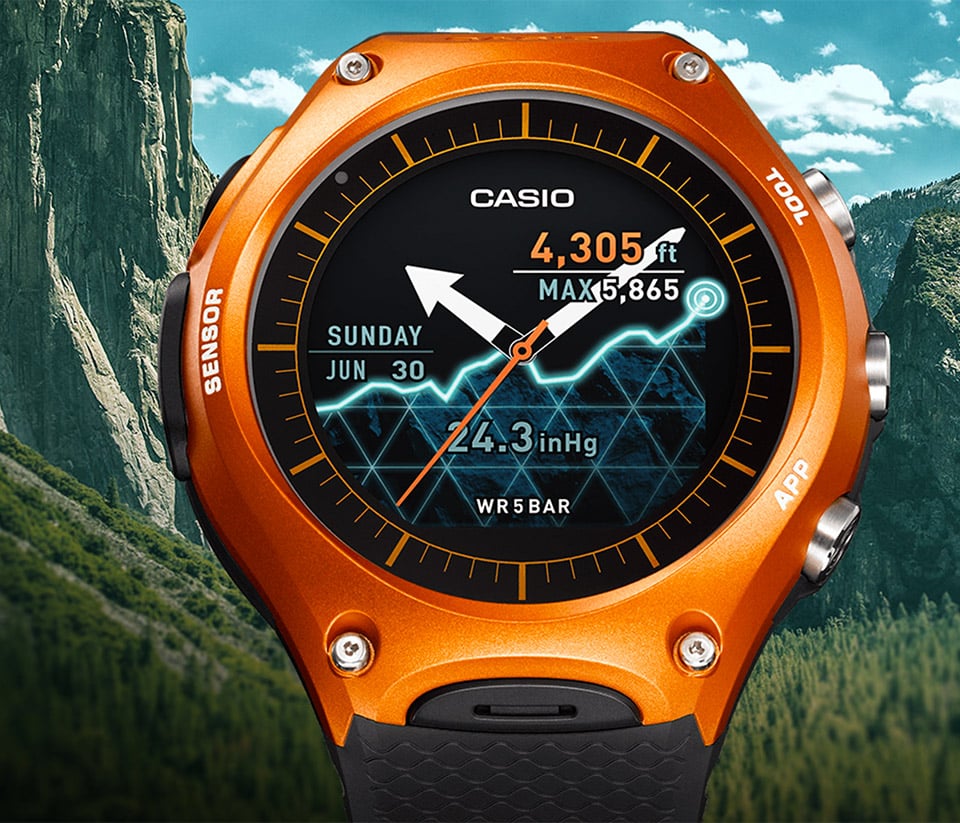
Officially designed as the WSD-F10, this smartwatch was built from the ground up for adventure travelers and the active outdoors person. As such, it comes equipped with a host of sensors and features that will make our life in wild and remote places much easier. For instance, the watch has a built-in electronic compass, altimeter, and barometer. It also comes with a database of the current times for sunrise and sunset based on your current location, and it even has a tide chart to help you plot the movement of bodies of water. Casio's device even serves as a fitness tracker too, closely charting your movement and calories burned throughout the day.

Despite all of that functionality baked into the Smart Outdoor Watch, there is one feature that is glaringly missing – GPS. Most high-end outdoor watches today come with some GPS capabilities that allow their users to track their routes, follow trails, and keep track of speed, distance, and direction. The WSD-F10 does all of those things, but it uses the GPS chips on the smartphone that it is tethered to in order to accomplish those feats. That means you'll need to carry your smartphone with you everywhere you go, including the backcountry. Considering how many of us already do just that however, it seems like a small price to pay, even if you now have to keep two gadgets – your phone and your watch – charged.


Speaking of keeping a device charged, if Casio's smartwatch has an area that needs improvement, it is probably battery life. Don't get me wrong, in standard operating mode, it will easily outpace the Apple Watch, lasting for as many as three days between charges. But, turn on a host of features, interact with apps on a regular basis, and have it track your movement while out on a hike, and suddenly the battery life begins to drop significantly. In fact, it is possible that you might not even be able to make it through a full day of usage if you turn all of its features on and leave them functioning for an extended period of time. As with most smartwatches that are currently available, this one could use a bit more juice.

Those issues aside, the WSD-F10 is a great watch for use while traveling and in the outdoors. It is rugged and durable enough to take anywhere, including into the water. This watch is waterproof down to 50 meters (164 ft) and it is both dustproof and hardened against drops according to the MIL-SPEC 810G standards. That means that you can take this watch on a trail run, mountain biking, and paddling and never worry whether or not it's going to survive.

Casio has used a unique two-screen system on this watch that not only allows it to show the current time at all times, but it can do so without wiping out the battery. The first display is a simple monochrome option not unlike something you might find on a Kindle. This particular screen is used to give users the time and date at a quick glance, even in bright sunlight. This low-power display sips energy from the battery, which is what allows it to be on all of the time. The second display is a full-color screen that is used for interacting with apps, reading text messages and alerts, and providing other information to the user. It is bright and vivid and on par with pretty much every display that I've seen on a smartwatch to date. This two-screen approach works seamlessly to the person wearing the watch and brings some versatility to the WSD-F10 that isn't found in its competitors.

While Apple uses its own proprietary Watch OS to power its wearable, Casio has employed Android Wear to run its device. This lightweight operating system has been designed specifically to run on devices such as the WSD-F10 and as a result it is fairly snappy in its execution and provides a solid platform for creating unique apps that can run on the device. Android Wear doesn't have nearly as many apps for it as Watch OS, but most of the big names that you would expect are there, and can be used with the Smart Outdoor Watch too, provided you use an Android phone. The WSD-F10 will pair with an iPhone, but its functionality is severely limited due to the restrictions that Apple places on access to iOS functionality.

One of my favorite features of most smartwatches is the ability to customize the face of the watch to display exactly the information that you want to see. The WSD-F10 has this same functionality built-in as well, but with a nod to its particular audience. Outdoor enthusiasts will appreciate that with a quick glance they can check their current altitude, direction they are moving, speed, route, and more. The sheer amount of customization that can be done is a bit surprising at first, but you'll soon discover that it is very nice to have that level of versatility right at your fingertips.

Priced at $500, the Casio WSD-F10 Smart Outdoor Watch is about on par with similar products from both Suunto and Garmin. However, those watches all tend to come with GPS built-in and have longer battery lives, which will make them more appealing to many customers. But, they also lack most of the "smart" features that make Casio's device so intriguing. If you don't mind recharging your watch more often, and are already carrying a smartphone with GPS capabilities, the WSD-F10 may just be the more full-featured option.

Personally, I really like this watch. The fact that it is a smart wearable designed for those of us who venture out to remote locations on a regular basis makes it a great option for adventure travelers and outdoor lovers. I appreciate its high quality construction, excellent built-in features, and expanding app ecosystem. This is a watch I can wear on daily runs and bike rides, as well as trips to the far side of the planet. That alone gives it a leg up on my Apple Watch, and makes me wish Apple would crate something similar. That will never happen, but thankfully Casio is here to fill the void.

Buy the Casio WSD-F10 Smart Outdoor Watch at REI.


Jumat, 26 Agustus 2016

Gear Closet: Victorinox Traveller Lite Swiss Army Knife

In terms of outdoor gear, there are few pieces of equipment that come close to being quite so iconic as the famed Swiss Army Knife. This handy tool can trace its roots all the way back to 1891, which is when the company that would eventually go on to be known as Victorinox would begin producing their first knives. Since then, those products have continued to evolve and are now shipped all of the world, with just about every outdoor enthusiast owning on at some point in their lives.

Recently, I carried the Victorinox Traveller Lite with me on my trip through Mongolia, and as usual, it proved itself to be a handy companion. The knife comes equipped with everything you need, and a few things you didn't even know you wanted, making it a useful item to have in your pack or pocket at just about any time.

Sorting through the incredibly long catalog of knives on the Victorinox website will probably leave your head spinning. There are so many choices to examine that it can be difficult to find the one that best suits your exact needs. But, the Traveller Lite was certainly a good choice for me, as it features just about every tool imaginable, including both large and small knife blades, a can opener, screw driver, a bottle opener, a corkscrew, scissors, and more. In short, it has about every tool you wold expect from a Swiss Army Knife, and they are all squeezed into a small enough space that it can easily be slipped into your pocket.


One thing that does set this knife apart from the scores of others that Victorinox makes is a small LCD screen that can be found on its translucent case. That screen displays the time, temperature, altitude and barometric pressure, all of which are handy features to have in the backcountry. The tiny screen is powered by a small watch battery that slides into a specially designated slot. That slot was kind of challenging to gain access to at first, but thankfully you shouldn't have to change the battery too often.

In terms of build quality, the Traveller doesn't disappoint. It feels solid in your hands, and as with most other Swiss Army Knives it has been designed to survive in demanding environments. Using the various tools doesn't give you the sense that anything is about to break, nor does it seem like any corners were cut in designing and assembling this product. I can't always say the same about similar knives I've used in the past, some of which have failed me at the most inopportune times. As with all knives from Victorinox, this one comes with a lifetime warranty as well, which means if something should break, you'll get it replaced for free.

I carried this knife with me everyday while in Mongolia, and even I was surprised at the number of times I pulled it out to use one of the various tools. The knife blades were probably the ones I needed most often in that setting, but others such as the integrated tweezers and toothpick came in handy from time to time too. At times, it felt like I was carrying a full tool box in compact form right in my pocket.

The Traveller Lite is one of the more expensive knives in the Swiss Army collection. At $111 it is probably a bit pricey for most outdoor enthusiasts who don't need all of its features. For those folks, I'd recommend something like the Huntsmen, which has many of the same tools – minus the electronic gadgetry – and sells for just $40. But, if you're someone who ventures into the backcountry often, or does a lot of mountaineering, the Traveller Lite is a good option. It's LCD screen displays some important information, and it provides plenty of good tools to see you through some demanding trips. For those folks, the $100+ price tag is worth the investment, and you'll likely have a tool that will accompany you on my future adventures.

Check out the entire line of Victorinox knives and other products at Victorinox.com.

Rabu, 24 Agustus 2016

Gear Junkie Gives Us 10 Gear Trends to Watch for in 2017

It's hard to believe but 2016 is already starting to wind down. Sure, we're still in the midst of the dog days of summer here in the Northern Hemisphere, but the final days of August is in sight, and we're only a few short months from the end of the year. With that in mind, our friends over at Gear Junkie have peered into their crystal ball and looked into the future, giving us 10 gear trends to watch out for in 2017.

For anyone who attended the Summer Outdoor Retailer convention a few weeks back, most of these trends won't come as much of a surprise. Walking the halls of the Salt Palace in Salt Lake City, Utah, it was clear where the industry is headed. But, those same trends aren't quite as clear to the outside observer who wasn't lucky enough to see all of the major outdoor brands collected under one roof.

So what can we expect from our gear in 2017? I won't spoil the entire list, but there are certainly a few items that are worth mentioning. For instance, there is definitely a concerted effort in the outdoor industry to make our gear more "green." Companies are searching for ways to use recycled materials for instance, and they are changing the way they manufacture their products so that they use less water and have a decreased impact on the environment. We've seen a few efforts in this direction in the past, but it is really picking up steam now. Over the next few years, those efforts will not only increase dramatically, they'll also become much more common place.

Other trends that Gear Junkie says we should watch for include more sophisticated drones, boots that grip ice better, and performance apparel that will help keep us cooler. The other items on the list are equally intriguing, and definitely reflect the same things I saw at OR.

If you're a gear nerd like me, you'll probably find GJ's list very interesting. The industry is definitely moving forward with some new initiatives and we'll all get the opportunity to benefit from it.

Selasa, 23 Agustus 2016

Gear Closet: Altra Lone Peak 3.0 Hiking Shoes

A couple of weeks back I took a look at the new Altra Superior 2.0 trail running shoes, and found them to be an excellent choice for runners. At the time I mentioned that I was testing another pair of shoes from the company as well, and was eager to put them through their paces. Last week while visiting Quebec I had the opportunity to do just that, and ended up coming away just as impressed.

This time out I was testing the new Altra Lone Peak 3.0 NeoShell Mid, a hybrid shoe of sorts that blends the best elements of a trail runner with a lightweight hiker. It features Altra's proprietary Foot Shape technology that allows for more room in the toe box for a more natural fit, and its Abound materials that allow energy to return to the foot when walking. They also have a zero-drop sole that allows both the forefoot and heel to strike the ground at the same time, which encourages better form throughout the length of your run or hike.

This being the "mid" version of the original Lone Peak shoe it comes with more ankle support built-in. This not only comes in handy when hiking demanding trails, it also gives the shoe a look that more resembles a hiking boot as well. Since I was using them more in that capacity rather than as trail runners, I appreciated the extra support, even on routes that weren't especially demanding.

When compared to other hiking shoes, the Lone Peak 3.0 Mid is extremely lightweight, tipping the scale at just 10 ounces (283 grams). That made them extremely easy to pack for my Canadian adventure, and helped to reduce fatigue when wearing them for extended periods of time, both on the trail and walking around town. In fact, I'd say that these shoes are more on par weight-wise with the trail running shoes I wear from other companies, rather than most hiking shoes. In other words, if you're in the market for a new pair of hikers and are looking to shave off some ounces, this just might be the shoe you've been looking for.


In terms of comfort, the Lone Peak feels more this a sneaker than a hiking shoe as well. They are very comfortable on your feet while still managing to provide a high level of support in all the areas you need it – most notably the arch, ankle, and footbed. I will say that my feet did get a bit warm at times thanks to the Polartech fabrics used in their construction, but not so much that they were actually uncomfortable. My feet tend to run warm most of the time anyway, so this wasn't completely surprising considering they were being worn on a summer hike.

The other important factor for a trail running or hiking shoe is traction on a variety of surfaces, and the Lone Peak doesn't disappoint here either. It uses Altra's new MaxTrac outsole and TrailClaw lugs to keep you sure footed even on rocks, mud, water, and fine dirt. I suspect they'd be fine on snow – and to a lesser extent ice – as well, although I haven't had the opportunity to test them in that environment just yet.

If there is one complaint I have about these shoes it is a minor one. They can be a bit tough to get on at first, as they have a narrow opening that can be difficult to slide your foot into without taking the laces out of the first few eyelets. The more I wore them however, the easier they were to get on my feet, in part because they started to loosen up some, and because I also learned the best way to get them into place. Still, I was put off by this at the beginning, so it is important to point out. Your first foray with these shoes may have similar results, so don't write them off based on that first impression.

That said, these are one of the more comfortable pairs of shoes that I've had the opportunity to try out in a long time. I really love the wide toe box that gives my feet plenty of room, and I appreciated the amount of cushioning and support that they provide too. On top of that, they are super versatile, transitioning from trail to town without missing a beat. I even wore them on a 35 mile bike ride and came away feeling great too. That makes them a nice set of footwear to have in your closet and a great choice for travelers too.

Priced at $160, these are the perfect shoes for fast packers, lightweight backpackers, trail runners looking for some extra ankle support, or hikers who just want a lightweight, yet durable option. Buy them now at CampSaver.