Tampilkan postingan dengan label Kayaking. Tampilkan semua postingan

Kamis, 06 Oktober 2016

Reminder: October 14th is a National Day of Adventure

As I get ready to head out of the country once again tomorrow, I wanted to take this opportunity to remind everyone that next Friday – October 14, 2016 – had been declared a National Day of Adventure by Men's Journal and Victorinox, the company behind the iconic Swiss Army Knife.

While not an official holiday of course, the entire point of the NDOA is to encourage people to get outside, engage in their favorite outdoor activities, or perhaps even try something new. To that end, the two sponsors of the Day of Adventure have helped organize more than 30 events across the U.S. to give us all a starting point for getting our adventures off to a good start.

While I'll actually be in Spain on that day, I'll certainly take some time to hit a trail and do some hiking, or possibly even some snorkeling in the Mediterranean Sea. And since it is a Friday, hopefully some of you will take part in the celebration by heading out to enjoy your own adventures too. Why not skip out of work early, grab your mountain bike and take a ride on your favorite trail? Or, gather up some friends and take a scenic hike somewhere before grabbing some dinner and drinks afterwards. The whole point is to add a little excitement and adventure back into your life, something that hopefully we do on a more regular basis than one day a year, but it is a good place to get started never the less.

So, whether your like to ride, hike, run, paddle, fly, climb, or some other crazy outdoor activity, don't forget to set a little time aside to pursue that passion next Friday. After all, you'll never regret the days that you do the things you love, and you might just discover other passions along the way.

Get out there and enjoy!

Rabu, 07 September 2016

Canadian Adventures: Paddling the Saguenay Fjord

As I mentioned in a previous piece about my recent trip to Quebec, Canada, the theme of the visit was "Must Love Water." As such, many of the activities that we took part in involved paddling a boat of some type. That included a stand-up paddleboard, a whitewater raft, and a canoe. But perhaps the best experience of the entire trip saw us loading up on sea kayaks and heading out onto the breathtaking Saguenay Fjord, a place of such natural beauty that it literally had to be seen to be believed.

After spending the better part of the week on waterways of one kind or another in the Saguenay-Lac-Saint-Jean region of Quebec I was beginning to think I had seen most of what there wast to experience there. After all, our whitewater run was a thrilling, adrenaline inducing affair, and even our canoe trip mixed in a taste of whitewater to keep things interesting as well. Both of those experiences took place in lovely settings with thick forests lining the shores of the rivers we were on, and scenic settings to pass through. As lovely as those settings were however, they couldn't compare with kayaking on the fjord.

On the day we were scheduled to go kayaking we spent the better part of the morning driving to the Parc National du Fjord-du-Sagueny (the Sagueny Fjord National Park) where we would eventually join our guide from OrganisAction, a local outfitter that organizes kayaking excursions there. The park itself has a lot to offer in addition to paddling. For instance, there are several self-guided hikes to take, each of which offers some great views of the surrounding landscape. But for the truly bold, there is also an impressive Via Ferrata that takes visitors high up onto the rocky cliffs on a trek that is is both beautiful and heart-stopping for entirely different reasons. Unfortunately, we weren't there to make that hike, so after a quick lunch it was off to find our guide and begin our waterborne adventure instead.

As usual with any guided kayaking excursion we had to first go through an orientation on how to paddle most efficiently, the best ways to enter and exit the boat, and how to steer the long sea kayaks that we would use on the fjord. I've had plenty of experience in this department and was more than ready to go, so thankfully it didn't take too long before we were dropping the kayaks into the water and setting out.


It didn't take long to figure out just why this region was declared a national park in Canada. A few paddles away from the dock and the impressive landscape began to take shape. High cliffs rose all around us, while tranquil water ran all the way from our put-in spot out into the middle of the fjord itself. On that day, with the sun shining high overhead and the clear blue water all around us, it was simply a magnificent place to be.

For those who don't know, a fjord is a long, narrow inlet that has typically been carved by a glacier, and has high, towering cliffs all around it. A true fjord is fed by salt water from the ocean, but in the case of the Saguenay Fjord, there is salt water underneath with a current of fresh water, fed from the Saguenay River, on top. This makes it a unique environment where both fresh and salt water fish and mammals can be found. In some parts of the fjord it is possible to spot whales or even Greenland sharks, while a variety of salmon and other fish from the river exist in the same space.

Our group paddled out into this aquatic wonderland with our jaws hanging open. Over the course of our week together we had seen some truly beautiful places, but this one the crowning jewel of the experience for sure. Paddling along the cool, but refreshing water was a relaxing affair, even when we took our boats out into the middle of the fjord itself. From there, we were afforded the best views of the waterway, able to look west towards the mouth of the river and east where the deep blue waters drifted off into the distance. I'm sure on a day where the weather isn't cooperative the fjord could be a harsh place to be, but on this day it was perfect.

One of the highlights of a kayak trip out onto the Saguenay Fjord is spotting the famous Virgin Mary Statue that adorns one of the cliff tops there. While not quite as large and imposing as the Christ the Redeemer statue in Rio, it is still a memorable sight to behold. The state was placed there by a local trader named Charles Napoleon Robitaille back in 1881. A few years prior to that, Robitaille was traveling across the frozen ice when it gave way beneath him. As he was pulled into the freezing cold water, he prayed to the Virgin Mary to save him, and somehow he found himself alive, out of the fjord, and on solid ice. After that, he vowed to do something to both commemorate the experience and thank the higher powers that he had lived. He made good on his promise and later had the statue installed.

Even from the water below the tall cliffs, the white statue of the Virgin Mary stands out against the lush green trees. The monument was another unique element to a place that was already amazing to look upon, and the story of how it got there only adds to the mystique of the place.

After spending several hours paddling the fjord it was time to head back to the shore, but not before making a detour along the opposite shore to catch a glimpse of a beautiful waterfall that tumbled down the rock face there. As we paddled we could see several such waterfalls in the distance, so it was nice to see one up close too. It was a brief stop over however, and before long we were steaming our way across the open water once again.

While we were out on the water, the tide had obviously come in. The dock that we had used as a put in earlier in the day had been sitting high and dry on the beach, allowing us to wade in a short distance before setting out. Now however, it was floating on the surface of the fjord, and the water had risen up to our waists. That made for a soggier exit, but the water felt good after a warm afternoon.

After dragging our boats back up on shore, it was time to say goodbye to our guide and the fjord. It was certainly a memorable day in the kayaks however, and one that I would love to do again. In fact, our guide mentioned that there are some primitive campsites along the shore of the fjord that stretch for miles. He said that adventurous kayakers like to paddle down the fjord and stay at those campsites as they go. With a good kayak, plenty of supplies and gear, it would be possible to go for days in this remote, and pristine wilderness. That sounds like the kind of trip I would enjoy doing.

If you're in the Saguenay-Lac-Saint-Jean region in the summer, a visit to the national park is a must-do adventure. Even if you can't get out on the water in a kayak – which I HIGHLY recommend you do – at least go for a hike and take in the surrounding landscape. It is a place that will definitely leave a lasting impression.

Selasa, 06 September 2016

Kayakers Complete Greenland to Scotland Challenge

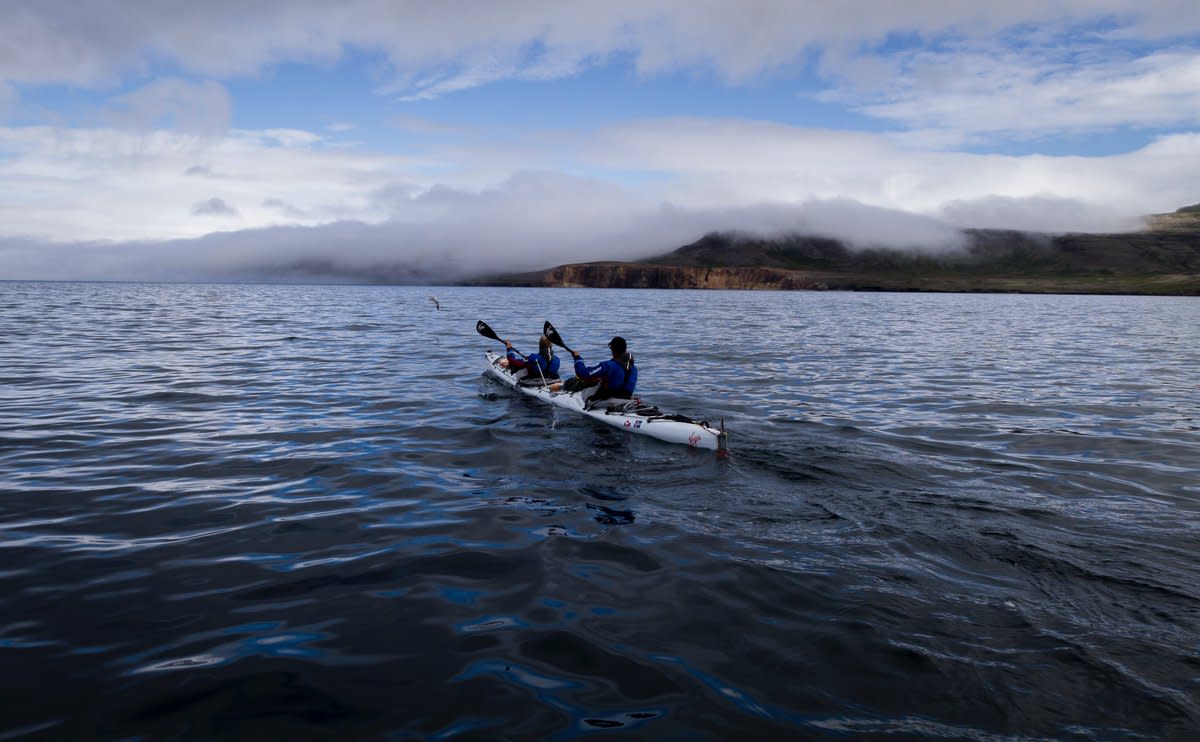
For the better part of the summer we've been following the progress of Olly Hicks and George Bullard, two British adventurers that had undertaken the difficult challenge of kayaking from Greenland to Scotland, and endeavor that included several legs of the journey that required them to be out on the open ocean for days at a time. Over the weekend, the pair reached their final destination at last, bring an end to their odyssey that was both mentally and physically taxing.

Hicks and Bullard launched their expedition from the Denmark Strait in Greenland before proceeding across open water to Iceland. From their, the two men followed the Icelandic coastline until they reached the North Sea, from which point they turned their boat towards the Faroe Islands, a very remote destination located just north of the British Isles. Next they crossed 50 miles (80 km) of rough seas to  reach the tiny island of North Rona before pressing on with the final leg, which ended
at Balnakeil Bay in Scotland. Along the way they faced several stops and starts due to inclement weather and exhaustion, but all told they managed to cover approximately 1200 miles (1931 km) over the the length of their adventure.

The expedition came to and end in the early hours of Sunday, September 4. Tired, but sensing that the end was near, Olly and George pushed on, paddling through the night. They reached Balnakeil Bay before sunrise, and although the blog reports of their progress say that they were exhausted, they were happy to reach the end of the journey at long last.

While this expedition saw little attention from the media, it was an audacious one to say the least. The waters that these two men paddled through were incredibly challenging, with ice floes blocking their way and heavy seas often making things rough. There are sections of the route that even commercial ships take care not to pass through, and yet Olly and George did it in a 22-foot sea kayak. That's a pretty impressive accomplishment indeed.

Congratulations to both men on a job well done.

Kamis, 01 September 2016

Video: The Ultimate Descent - From Everest to the Indian Ocean

In 2011, Sanobabu Sunuwar and Lakpa Tshiri Sherpa completed one of the most difficult and unexpected adventures in recent memory. The two men began by climbing to the summit of Everest, where they then deployed a paraglider and launched from the summit, flying down the Khumbu Valley to Namche Bazaar,  where they then embarked on the second stage of their journey – a kayaking trip down the Sun Kosi River that would ultimately take them to the Indian Ocean. Along the way they faced Class V rapids and the real threat of drowning, even as the Nepal military was searching for them since their Everest flight wasn't exactly sanctioned.

This video is from a news report about this crazy expedition. It was obviously filmed not long after they made the climb, flight, and paddle. The clip was recently posted online however, and for those that don't know the story, it is an interesting one. It was quite the adventure going from the summit of the world's tallest mountain to the sea level in just a few short weeks.

Rabu, 31 Agustus 2016

Gear Closet: Body Glove 3T Barefoot Warrior Water Shoes

We live in a great time for the outdoor industry. Not only is our gear getting better all the time, it is getting more technical and specialized too. Case in point, over the past few years I've gone from a guy who had just a few pairs of shoes in his closet to someone who now owns the perfect shoe for whatever outdoor activity I'm heading out to take part in. But recently, I added a new pair of footwear to my growing collection in the form of the 3T Barefoot Warrior water shoe from Body Glove, which have delivered lightweight versatility for all of my favorite waterborne adventures.

If you read my article yesterday about whitewater rafting in Quebec you know that my recent trip to that part of Canada was all about spending time on the water. In fact, while I was there I not only went rating, but canoeing, kayaking, and stand-up paddleboarding too. All of those activities were an opportunity to test the 3T Barefoot Warrior in a variety of different aquatic settings, and I can honestly say after using them for a week on the water, I came away very impressed.

These shoes feature a unique design that somewhat resembles Vibram's popular Five Fingers line. But where those shoes require you to jam all of your toes into individual slots, Body Glove has taken the wise step of using a three-toed design instead. As a result, I found it much easier to get the 3T Barefoot Warrior on than I ever did using the Five Fingers. That's because by big toe and second toe can easily slide into place, while the remaining three fit nicely into a larger compartment. On Vibram's offerings I always had to force those last three toes into their proper slots, which felt a bit unnatural to me.

Once the 3T Barefoot Warriors are on my feet, they feel far more natural and comfortable too, providing plenty of protection while still maintaining a good sense of balance too. In fact, up until I had these shoes I had always gone stand-up paddling barefoot as it helped to create the surest connection between my feet and the board I was using. But with Body Glove's shoes I was able to still keep my balance, even on a board that was not amongst the most stable that I have ever used.

As with any water shoe, drainage is of the utmost importance. Fortunately, Body Glove did a great job designing this shoe to allow water to move in and out quickly and easily. That same drainage system also serves to create ventilation for the foot when you're not in the water too, helping it to stay cooler while on land. As a result, you can easily transition in and out of the water without missing a beat.

Made from lightweight, quick-drying materials the 3T Barefoot Warrior are durable and comfortable enough that you can wear them all day without fear. Other water shoes have tended to chafe my feet at times when I wasn't in the water, but I didn't experience that at all here. And while you may get some strange looks wearing them around town, if you do have to wear them in that environment, you're feet won't complain one bit.

If you're in the market for a lightweight and versatile pair of water shoes that you can use in a wide variety of activities, the 3T Barefoot Warrior is an excellent option. I personally really like how they fit on my feet and how well they hold their grip, even on slick surfaces. The fact that they are also highly comfortable is a nice bonus, while the three-toed design makes them easy to get on and off and aids balance too. At $59.99 I think these shoes are a steal, and I believe anyone who takes part in water sports with any regularity will agree. Whether you kayak, SUP, swim, snorkel, or raft, this is a shoe that you'll want in your closet too.

Find out more at BodyGlove.com.