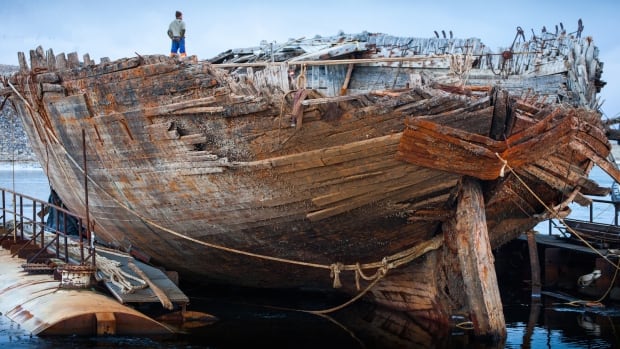
After resting at the bottom of the ocean for more then 85 years, Roald Amundsen's ship the Maud has been brought back to the surface, and is preparing to return to Norway. The ship, which was discovered off the coast of Cambridge Bay in Canada, helped to chart the Northeast Passage from 1918-1920, sunk in those waters back in 1930 after a short, but distinguished career in exploration.
A recovery team has spent the past six years working to bring the ship up from its watery grave. This past July, their efforts finally paid off, as the ship returned to the surface for the first time in more than eight decades. The crew first had to place a series of inflatable ballasts around the hull of the vessel, then slowly add air to them. Eventually this allowed them to place it on a barge and float it into harbor. Over the past two months, they have been been cleaning up the interior of the vessel in preparation for weathering the winter in the Arctic.
The recovery team says that the winter weather will actually help the ship, allowing its wooden hull to dry. This will help to reduce the ship's current weight, and will take some of the pressure off of the hull. That will help to stabilize it for the long journey back home to Norway, which is likely to take place next summer.
According to reports, the ship is in surprisingly good shape. The hull remains solid and strong, despite being at the bottom of the ocean for so long. The vessel was originally built back in 1917, and commissioned by Amundsen to accompany him on his exploration of the icy waters north of Russia. Amundsen is well know for is exploits in the cold places of our planet. He was the first person to reach the South Pole back in 1911, and was instrumental in exploring the Arctic as well, becoming the first person to full pass through the Northwest Passage.
The Maud was sold off in 1925, five years before she sank. But, she is considered an important piece of exploration history, and back home in Norway she'll be preserved for posterity. In that country, Amundsen is incredibly famous, and any relic left over from his expeditions is a valuable commodity.
This is quite a cool story. I'm glad this team was able to locate and recover the ship. Hopefully it makes it through the winter in one piece, and returns home next year as planned.
Tampilkan postingan dengan label Arctic. Tampilkan semua postingan
Senin, 03 Oktober 2016
Kamis, 15 September 2016
Arctic Explorers Bring Bad News After Sailing Northwest and Northeast Passages
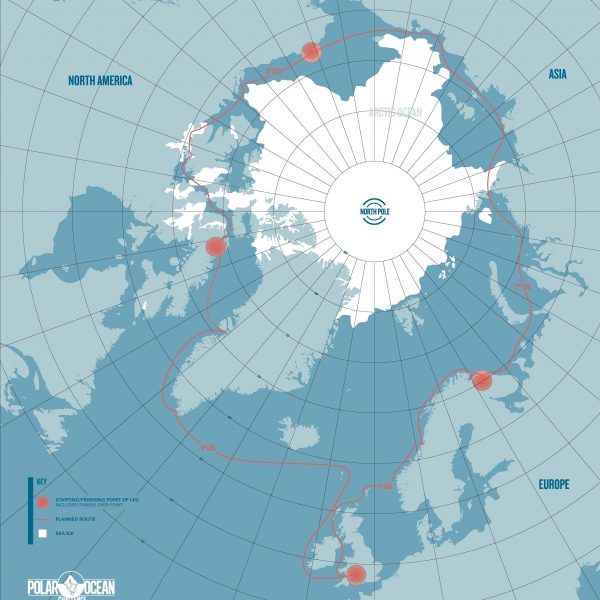
One of the most ambitious and interesting adventures of the summer has been the Polar Ocean Challenge. Led by famed explorer David Hempleman-Adams, the objective of the expedition was to sail both the Northeast and Northwest passages in a single year, circumnavigating the North Pole and taking stock of the arctic sea ice along the way. A few days back the crew of adventurers, sailors, and researchers completed a major milestone of their journey, and they brought back some sobering news about the state of ice in the Arctic Ocean.
The sailing ship Northabout set sail from Bristol, in the U.K. back June, making way for Norway before proceeding on to Russia to the start of the Northeast Passage. The ship ran into a delay at that point due to pack ice still blocking the route. That isn't too uncommon in the early part of summer, as it generally takes a few weeks before the passage clears. From there, they navigated on through the icy waters of the Arctic before exiting into the Northern Pacific and crossing over to Alaska. The next stage of the journey was through the Northwest Passage above Canada, which is the section that was just completed. Now, the plan is to sail on to Greenland, and then back home to Bristol.
By successfully navigating through the both the Northwest and Northeast passages, the crew proved that those once mythical routes are now fully open, and accessible. They also became the first ship to make such a journey in a single season, although they certainly won't be the last. Climatologists now predict that both passages will see increasing numbers of commercial traffic before the middle of the century, even by ships that are not hardened against ice.
On the Polar Ocean Challenge website the team posted a press release a few days back sharing the news of their successful completion of the Northwest Passage, which took just 14 days to finish. That's an incredibly fast time through that part of the world, but the team revealed that they had encountered almost no ice along the entire route. In fact, in the two weeks that they spent there, they came across ice only twice in 1800 nautical miles (3333 km/2071 miles).
This news is both astonishing and troubling at the same time. It now seems pretty clear that both the Northwest and Northeast Passages will soon be open for longer periods of time each year, and that they will be safer than ever to pass through. The Arctic sea ice is a bit like the canary in the coal mine, giving us an indicator of just how much impact climate change is having on our planet.
The crew of the Northabout is on the home stretch now, having completed the most difficult sections of their voyage. The team's website shares some important information about their expedition, which has now been at sea for more than 20 weeks and covered over 13,500 nautical miles (24,076 km /14,960 miles). Perhaps the most startling statistic of all however, is that researchers about the ship have recorded a 13.4% drop in the sea ice levels, which is a faster and higher rate than was expected.
I suspect these kinds of reports will become the norm moving forward. It is still troubling to read however.
The sailing ship Northabout set sail from Bristol, in the U.K. back June, making way for Norway before proceeding on to Russia to the start of the Northeast Passage. The ship ran into a delay at that point due to pack ice still blocking the route. That isn't too uncommon in the early part of summer, as it generally takes a few weeks before the passage clears. From there, they navigated on through the icy waters of the Arctic before exiting into the Northern Pacific and crossing over to Alaska. The next stage of the journey was through the Northwest Passage above Canada, which is the section that was just completed. Now, the plan is to sail on to Greenland, and then back home to Bristol.
By successfully navigating through the both the Northwest and Northeast passages, the crew proved that those once mythical routes are now fully open, and accessible. They also became the first ship to make such a journey in a single season, although they certainly won't be the last. Climatologists now predict that both passages will see increasing numbers of commercial traffic before the middle of the century, even by ships that are not hardened against ice.
On the Polar Ocean Challenge website the team posted a press release a few days back sharing the news of their successful completion of the Northwest Passage, which took just 14 days to finish. That's an incredibly fast time through that part of the world, but the team revealed that they had encountered almost no ice along the entire route. In fact, in the two weeks that they spent there, they came across ice only twice in 1800 nautical miles (3333 km/2071 miles).
This news is both astonishing and troubling at the same time. It now seems pretty clear that both the Northwest and Northeast Passages will soon be open for longer periods of time each year, and that they will be safer than ever to pass through. The Arctic sea ice is a bit like the canary in the coal mine, giving us an indicator of just how much impact climate change is having on our planet.
The crew of the Northabout is on the home stretch now, having completed the most difficult sections of their voyage. The team's website shares some important information about their expedition, which has now been at sea for more than 20 weeks and covered over 13,500 nautical miles (24,076 km /14,960 miles). Perhaps the most startling statistic of all however, is that researchers about the ship have recorded a 13.4% drop in the sea ice levels, which is a faster and higher rate than was expected.
I suspect these kinds of reports will become the norm moving forward. It is still troubling to read however.
Rabu, 14 September 2016
Polar Bears Trap Russian Research Team Inside Arctic Base
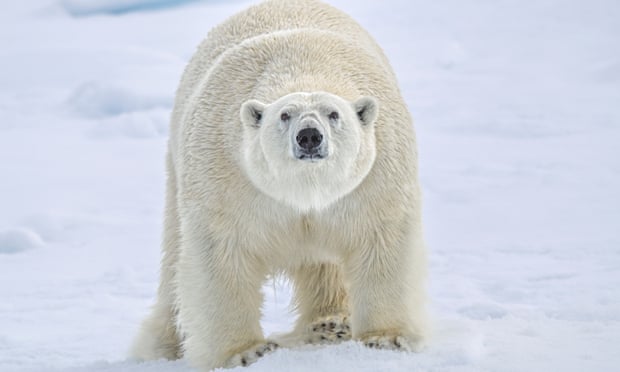
Think your job is rough? Consider the challenges that a team of five Russian scientists have been facing as they conduct weather research on the remote island of Troynoy in the Arctic Ocean. According to a report from TASS the group had become trapped inside its meteorological observation center by a group of ten polar bears who have taken up residence just outside the base.
Normally, in order to keep the bears at bay, the scientists use flares and have dogs at the base to scare off the animals. But, the team had run out of flares, and according to Mashable the bears even killed one of the dogs. Because of this aggressive nature, the researchers have had to abandon some of their projects, and had been instructed to only leave the base when absolutely necessary.
It was originally reported that it would take weeks to deliver new flares and dogs to the station, but apparently relief came earlier today when a passing research vessel made a detour to lend a hand. The ship resupplied the team with flares, which were used immediately to scare off the bears. The next resupply ship wasn't scheduled to arrive for another month, but this should help buy the team some time.
Apparently, the bears gather near the base to wait for the Arctic Ocean to freeze. That typically occurs in late October or early November, at which time they'll depart the area and head north. Considering the current state of the arctic sea ice, it may take longer than usual before the bears begin their migration, and it is possible that they'll return to that location again in the days ahead.
In the past only about 4-6 bears have spent their summers on Troynoy, but apparently this year there are at least 10, including some large female with small cubs as well. One of the females has even been spending her nights just below one of the windows of the weather station, making it even more difficult for the team to sneak outside to record readings for their research.
Hopefully there will be some relief for these scientists soon. While watching polar bears up close sounds like an amazing experience, being locked inside and unable to go out doesn't seem like a lot of fun.
Normally, in order to keep the bears at bay, the scientists use flares and have dogs at the base to scare off the animals. But, the team had run out of flares, and according to Mashable the bears even killed one of the dogs. Because of this aggressive nature, the researchers have had to abandon some of their projects, and had been instructed to only leave the base when absolutely necessary.
It was originally reported that it would take weeks to deliver new flares and dogs to the station, but apparently relief came earlier today when a passing research vessel made a detour to lend a hand. The ship resupplied the team with flares, which were used immediately to scare off the bears. The next resupply ship wasn't scheduled to arrive for another month, but this should help buy the team some time.
Apparently, the bears gather near the base to wait for the Arctic Ocean to freeze. That typically occurs in late October or early November, at which time they'll depart the area and head north. Considering the current state of the arctic sea ice, it may take longer than usual before the bears begin their migration, and it is possible that they'll return to that location again in the days ahead.
In the past only about 4-6 bears have spent their summers on Troynoy, but apparently this year there are at least 10, including some large female with small cubs as well. One of the females has even been spending her nights just below one of the windows of the weather station, making it even more difficult for the team to sneak outside to record readings for their research.
Hopefully there will be some relief for these scientists soon. While watching polar bears up close sounds like an amazing experience, being locked inside and unable to go out doesn't seem like a lot of fun.
Senin, 08 Agustus 2016
Video: Nat Geo Shares Earliest Archival Footage
Want to see the earliest archival video footage from National Geographic's extensive vault of films? The video below provides a glimpse of just that as it gives viewers a look at the 1903 Ziegler North Pole Expedition. The explorers that made up that team set out from Norway with plans to reach the North Pole. But, their ship got trapped in the ice and the group ended up stranded for a year. This video gives us a look at a bygone era in exploration and a sense of what it was like for that team as they set off into the unknown. Interesting stuff to be sure.
Langganan:
Postingan (Atom)